Quick Answer
HPM iControl is a discontinued Australian home automation platform. Legrand acquired HPM and ended production, iBAS software distribution and manufacturer support. Nothing is manufactured any more, though remaining parts stock still exists — which means many systems can still be repaired today, but not indefinitely. When replacement is the right call, Clipsal C-Bus by Schneider Electric is the natural path: it shares the same DIN-rail architecture, so most existing cabling can be reused. Fixed-price upgrades start from $8,000 + GST and include Apple Home integration.
What HPM iControl actually was
HPM iControl was a fully programmable home and building automation platform developed by HPM — an Australian electrical manufacturer — in the late 1990s. At its peak in the 2000s renovation boom, it was one of the most widely installed smart home systems in high-end Sydney, Melbourne, and Brisbane homes.
The system used a DIN-rail architecture: dimmer and relay modules mounted in the electrical switchboard, connected via a 2-wire ELV communications bus — orange figure-8 cable, joined with IDC crimp connectors — to keypads, touch screens, and sensors throughout the home. Programming was done through proprietary software called iBAS (Intelligent Building Automation Software), which connected to the H2A control panel over a serial link.
What iControl controlled
Interior and exterior lighting, exhaust fans, air conditioning, reticulation, pool equipment, automatic blinds, and multi-room audio — all managed from DIN-rail modules in the switchboard and low-voltage keypads on the wall. Many systems also included a full security package with occupancy sensors, sirens and PIN keypads.
Its closest modern comparison is Clipsal C-Bus. Same philosophy: centralised switchboard intelligence, low-voltage data bus, addressable keypads. iControl was genuinely ahead of its time. The problem was never the concept — it was what happened to the manufacturer.
Why it was discontinued — the Legrand story
In the mid-2000s, French electrical giant Legrand acquired HPM. Legrand already had its own home automation platform — MyHome (formerly BTicino) — and iControl was a direct competitor to their global product line. The business decision was straightforward: iControl was killed off.
The iControl licensing and remaining parts supply passed to a small Sydney-based company, Paelex, who could service existing systems while stock lasted. No iControl hardware has been manufactured anywhere in the world for years. The iBAS programming software is no longer officially distributed, and it requires period-correct hardware to run — which is why very few contractors can still open a system, let alone diagnose one.
The practical reality in 2026
Remaining stock still exists in Australia, so a failed module can often still be replaced today. But nothing is being made, supply only shrinks, and the systems themselves are now approaching twenty-five years of continuous operation.
That makes replacement a question of when, not whether. The useful thing is to control the timing — plan the upgrade rather than have a dead switchboard decide it for you on a Friday afternoon.
The technical reasons iControl systems fail
We work on these systems across Sydney regularly, and the failure pattern is consistent. Most iControl installations date from the early-to-mid 2000s, which puts the oldest at more than twenty years of continuous operation. Here's what actually degrades:
Thermal stress on dimmer modules
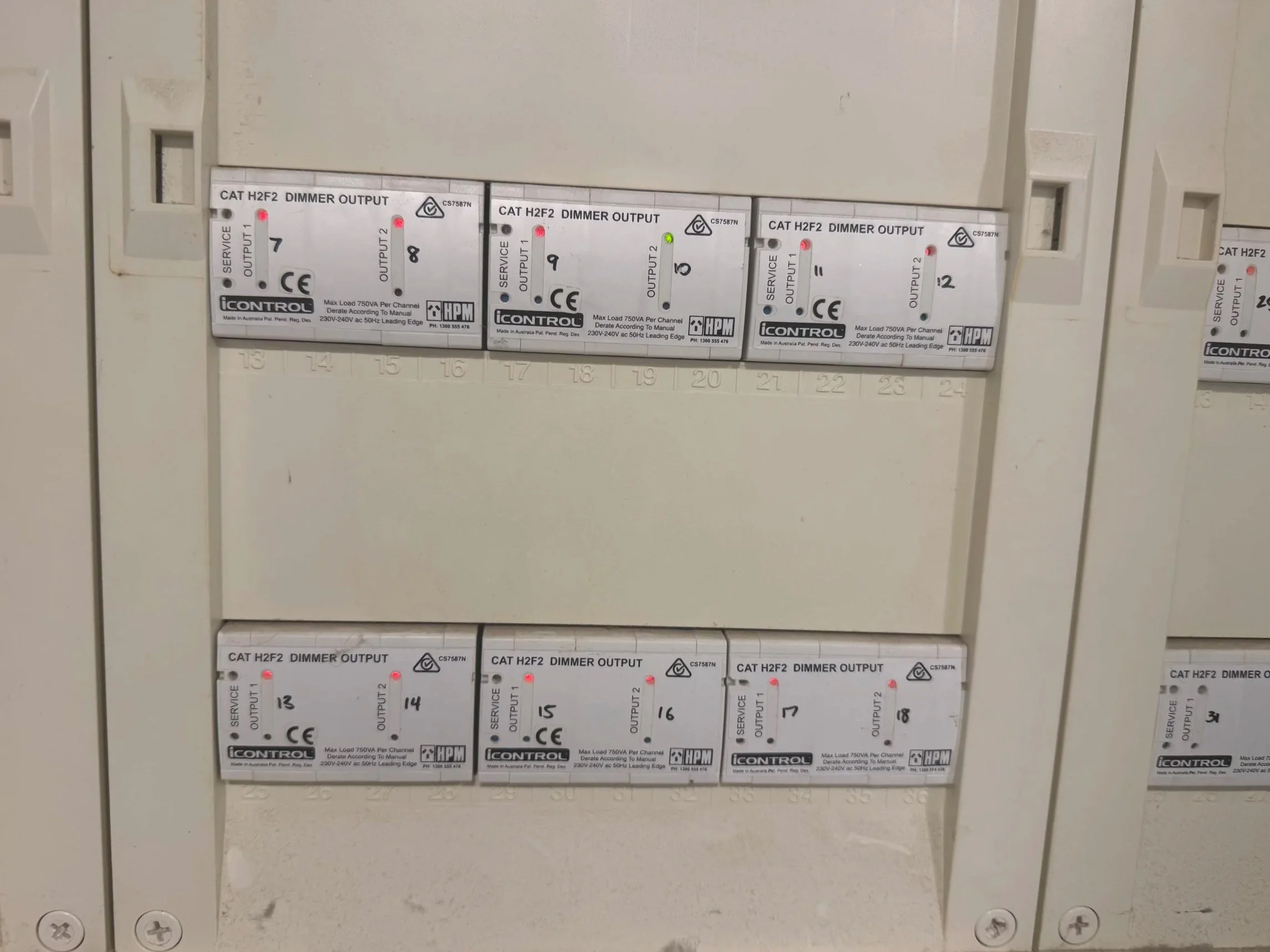
The CAT H2F2 dimmers were derated heavily when mounted side by side — a rack of four with no ventilation is rated well below a single unit, and many were installed without that derating applied. Heat degrades capacitors and TRIAC components over years. Channels become intermittent, then stuck, then dead.
Backup batteries past their life
The sealed lead-acid batteries in the H2B power supplies were rated for a few years, not two decades. On security-enabled systems, missing or flat batteries can prevent the alarm arming at all. This one is a straightforward repair.
LED incompatibility
iControl dimmers pre-date LED lighting entirely. They were designed for halogen and dichroic loads with a minimum load per channel. LED retrofits routinely fall below what the dimmer needs, causing flicker, ghosting, and limited dimming range. Covered in detail below.
Bus and connection faults
The figure-8 bus is joined with IDC crimp connectors, which corrode and loosen over decades. Keypads drop commands or go dead entirely. Often mistaken for a failed keypad when the actual fault is a connection or a tired power supply.
Touch screen and controller failure
iControl touch screens ran on early-2000s embedded hardware. Displays fail, screens freeze, controllers crash. These are the hardest components to replace and the most common trigger for a full upgrade decision.
Channels loaded to capacity
Many systems were installed at or near the rated capacity of their dimmer modules. Twenty years of continuous operation at high load takes its toll — channels stop regulating smoothly, or fail outright.
Why LED downlights break a working system
This deserves its own section, because it's the single most common reason a perfectly functional iControl system suddenly starts misbehaving — and it's routinely misdiagnosed as hardware failure.
The halogens get swapped for LEDs. The lights go in fine. Then: flicker at low levels, lights that won't dim below about a third, lamps glowing faintly when they should be off, a buzz from the switchboard, one room behaving completely differently from the next on identical-looking fittings.
The system hasn't failed. It's doing exactly what it was designed to do, with loads it was never designed for.
The engineering behind it
iControl dimmers are leading-edge units built for halogen and dichroic lamps, and each channel needs a minimum load to switch cleanly. The common H2F2 module specifies 40W minimum per channel. Six 50W halogens drew around 300 watts. Six LED replacements might draw 45.
On paper you're above the threshold. Electrically you often aren't, because LED drivers behave nothing like the wire-wound and electronic transformers these dimmers were designed and tested against.
It isn't universal
Some iControl dimmer modules tolerate LEDs far better than others — the later adaptive leading and trailing-edge commercial units handle LED drivers much more gracefully than the standard two-channel H2F2. Systems running DALI fluorescent dimming aren't affected at all, because DALI is digital signalling rather than phase cutting.
And if you're on the Northern Beaches, flicker is frequently mains signal interference from the network operator rather than anything in your switchboard — we've written that up separately.
The important point: this is a compatibility problem, not a dead system. Depending on what's in your board, the fix might be a different lamp, a load correction, a different dimmer module, or a programming change to the dimming curve. Don't accept "the system is broken" as a diagnosis because new lights flicker — and don't replace a whole system over it before someone has actually tested a circuit.
Repair or replace — where the line sits
The most common question we get on an iControl quote is: "Can't you just fix what's broken and leave the rest?" It's a fair question, and the honest answer is: often yes, for now.
We repair and reprogram iControl. We hold parts, and we run the original iBAS software — which almost nobody else does. So we're not going to tell you the platform is unfixable, because that isn't true.
What is true is that the economics shift as more of the system fails. Here's roughly how we call it:
| Your situation | Our recommendation |
|---|---|
| System works, one fault, parts available | Repair |
| Flat backup batteries, dead panel battery | Repair |
| Dead keypad, bus or crimp fault | Repair |
| Want scenes, buttons or sensors changed | Reprogram |
| Flicker after an LED upgrade | Test and correct |
| Several modules failed | Replace |
| Parts for your fault can't be sourced | Replace |
| Touch screen or controller dead | Replace |
| You want phone, Siri or app control | Replace |
| Renovating, or adding circuits and zones | Replace |
The genuine waste isn't money spent on repairs — a well-diagnosed repair keeps a working system running for years. The waste is money spent on contractors who can't diagnose the platform: attendance fees, hours of guessing, parts swapped speculatively, and the fault still there at the end of it. We've spoken to homeowners several thousand dollars into that cycle before anyone identified what was actually wrong.
Our position on this
If your system is repairable, we'll repair it and tell you roughly how long it's likely to keep going. If it isn't, we'll say so before we attend rather than billing you to find out.
Full detail on what we can service is on the iControl repair page.
Not sure if your system is repairable or needs replacing? Send us a photo of your switchboard — we'll tell you which it is before anyone attends.
Why C-Bus is the right replacement
We're C-Bus specialists — not because we picked a favourite, but because it's the correct answer for iControl replacement in Australia, and it's worth explaining why rather than just asserting it.
Architectural compatibility
Both systems use the same fundamental concept: intelligence in the switchboard, data cable to the wall, addressable devices on a shared bus. This isn't coincidence — it was the dominant design philosophy for premium home automation in Australia throughout the 2000s. That compatibility is what makes cable reuse possible.
Actively manufactured and supported
C-Bus is made by Schneider Electric, a global company with Australian operations. Modules are stocked at electrical wholesalers across the country. The programming software (C-Bus Toolkit) is actively developed and supported. If a module fails in ten years, you buy another one — which is precisely the guarantee iControl can no longer offer.
Native LED dimming
Modern C-Bus dimmers are designed for LED loads, with trailing-edge and universal options and far lower minimum load requirements. The flicker problem described above largely disappears — and where it doesn't, there's a current replacement module that solves it.
Apple Home integration
C-Bus integrates with Apple Home through a local hub (a HomePod mini or Apple TV 4K). Once integrated, every light, blind, and circuit is controllable from any iPhone, iPad, Apple Watch, or Mac — with Siri voice commands, automations, and remote access when you're away. All processing happens locally.
| Capability | HPM iControl | Clipsal C-Bus |
|---|---|---|
| Manufacturer still active | No — discontinued | Yes — Schneider Electric |
| Spare parts | Remaining stock only | Stocked nationally |
| Programming software | iBAS — no longer distributed | C-Bus Toolkit — active |
| Apple Home / Siri | Not supported | Full integration |
| LED dimmer compatibility | Problematic | Native LED support |
| Existing cabling reuse | — | Typically yes |
| Technician availability in Sydney | Very limited | Wide — Cync Electrical |
| Resale value impact | Often flagged as a defect | Recognised standard |
What happens to your existing wiring
This is the biggest practical question in any iControl upgrade, and the answer is usually good news.
iControl used a 2-wire ELV communications bus running from the switchboard to each keypad and sensor location. C-Bus uses the same topology and a similar cable specification. In most Sydney homes the existing cable runs can be reused.
The mains power wiring — switchboard to light fittings — is fully retained. You're replacing the brains (the DIN-rail modules), the input devices (keypads), and the controller. The infrastructure stays.
What this means for your home
No chasing of walls. No re-routing of cables. No replastering or repainting. The disruption is limited almost entirely to the switchboard and the keypad locations — not the walls in between. That's what keeps both cost and hassle well below a smart home built from scratch.
The exception is homes where the original cabling was installed to a lower standard, or where you're adding functionality as part of the upgrade — extra zones, new sensor positions, touch screens. We identify that during the site assessment rather than discovering it mid-job.
What the upgrade process looks like
Here's what actually happens on site, in order:
-
Site assessment
We inspect the existing hardware, test every circuit, check cabling condition, count keypad and sensor locations, and confirm scope. This is where we identify any cabling that won't carry over. You receive a fixed-price quote within one business day.
-
DIN-rail module replacement
The iControl dimmer and relay modules are removed and replaced with C-Bus equivalents. The switchboard stays; the modules inside it change. Mains connections are transferred across.
-
Keypad and sensor installation
iControl keypads are replaced with C-Bus equivalents at the same wall locations. The existing data cable terminates into the new keypad. No wall patching in standard cases.
-
C-Bus programming
Every circuit, scene, schedule and keypad function is programmed in C-Bus Toolkit. We replicate the behaviour that worked and improve what didn't. Done on site and tested live before we leave.
-
Apple Home integration (if included)
A local hub is configured — typically HomePod mini or Apple TV 4K — and your system is mapped into the Apple Home app. We test every circuit from an iPhone before handover, and set up automations and Siri shortcuts with you.
-
Testing, handover and backup
Every circuit tested at the keypad, in the app, and by schedule. We walk you through the system, leave a handover document, and retain a backup of the project file so future changes never start from scratch.
What it costs in Sydney
We quote fixed prices, not hourly rates, so there are no surprises once we're on site. The price you're quoted is the price you pay. Typical starting points:
Essential
$8,000 + GST
Smaller homes · Up to ~20 circuits
- iControl dimmer/relay module replacement
- C-Bus keypad installation
- Scene and schedule programming
- Full circuit test and handover
Standard
$14,000 + GST
Most Sydney homes · 20–40 circuits
- Everything in Essential
- Touch screen replacement
- Apple Home / Siri integration
- Multi-zone scene design
- HomePod mini or Apple TV 4K hub
Whole-Home
POA
Large homes · 40+ circuits
- Everything in Standard
- Blinds and HVAC integration
- Security and intercom linking
- Custom automation logic
Final pricing depends on circuit count, keypad count, touch screens, and any additional integration. A site assessment is required for an exact quote, and we do that free of charge for any iControl replacement job in Greater Sydney. (A repair callout is a different service and is charged — a replacement assessment is scoping work, not diagnosis.) Full package detail is on the iControl replacement page.
Frequently asked questions
Not by the manufacturer. Legrand, who acquired HPM, ended production, software distribution and technical support. Licensing and remaining parts supply passed to a small Sydney company, Paelex. A handful of specialists — ourselves included — still hold parts and can service and reprogram these systems, so repair is often still possible. But nothing is being made, so that supply only shrinks.
Repair usually wins if the system works and the fault is a backup battery, a keypad, a bus connection, or programming. Replacement makes more sense once several modules have failed, when the specific parts you need can't be sourced, or when you want capability the platform never had — reliable LED dimming, phone and voice control, or new zones. Because supply is finite, most systems will eventually need replacing; repair buys you time to plan it properly.
In most homes, yes. iControl uses a 2-wire ELV communications bus which is architecturally compatible with C-Bus data cabling. The mains power wiring from switchboard to fittings is fully retained. The DIN-rail modules and keypads are replaced; the cable runs and switchboard infrastructure stay. We confirm cabling condition during the site assessment.
iBAS (Intelligent Building Automation Software) was the programming platform for iControl. It connected to the H2A control panel over a serial link and ran on Windows XP-era hardware. Legrand no longer distributes it, and it needs period-correct equipment to run — which is why so few contractors can offer it. We maintain a working setup, so scenes, keypad functions, dimmer levels and security zones can still be changed. What it can't do is repair failed hardware.
iControl dimmers are leading-edge units designed for halogen and dichroic lamps, and each channel needs a minimum load to switch cleanly — the common H2F2 module specifies 40W minimum per channel. Six 50W halogens drew around 300 watts; six LED replacements might draw 45. LED drivers also behave very differently to the transformers these dimmers were tested against, so a circuit can sit above the stated threshold on paper and still flicker. It's a compatibility problem rather than a failed system, and it's often correctable without replacing anything.
Usually thermal degradation of TRIAC or capacitor components after two decades — accelerated where modules were mounted side by side without the derating the manufacturer specified. Channels loaded near their rated capacity fail sooner. A genuinely dead channel needs the module replaced, which is possible while stock lasts. Before assuming the worst, though, it's worth confirming it isn't an LED load problem, which presents similarly and is far cheaper to fix.
Yes. C-Bus integrates with Apple Home through a local hub — a HomePod mini or Apple TV 4K. Once configured, every circuit appears in the Apple Home app on iPhone, iPad, Apple Watch and Mac, with Siri voice control across all of them. Automations run locally on the hub rather than Apple's servers, so the home responds in under a second and keeps working when the internet is down.
A typical Sydney home with 20–40 lighting and power circuits takes 2–4 days on site. That covers switchboard module replacement, keypad installation, C-Bus programming, end-to-end testing, Apple Home setup and handover. Larger homes with 40+ circuits, complex integrations or multiple touch screens may take 5–7 days.
They're separate but closely related. Oscar Systems was a rival Australian home automation platform using the same DIN-rail and low-voltage bus architecture as iControl. Oscar has also been discontinued, leaving homes across Sydney and Melbourne without support or spare parts. The C-Bus upgrade path applies to Oscar systems in the same way.