C-Bus Repairs on the Northern Beaches.
Flickering LED downlights, dead keypads, lights switching themselves on, storm damage — we diagnose and fix C-Bus faults from Manly to Palm Beach. Licensed electricians and C-Bus specialists, from $295.
Quick Answer
Why do C-Bus LED downlights flicker on the Northern Beaches? The most common cause in this region is not a faulty dimmer — it's mains signal interference. Ausgrid sends ripple control signals through the transmission network to switch off-peak hot water and other controlled loads. On the Northern Beaches this signal is often strong enough to disturb electronic C-Bus dimmers, which read it as a change in the waveform and respond by flickering or dimming down. It affects lights on the C-Bus system while lights plugged into ordinary power points behave normally — the tell-tale sign homeowners describe to us.
It is fixable. Depending on severity, the solution is selecting LED downlights that tolerate the interference, changing to a more suitable dimmer module, or — in the worst cases — moving the circuit off dimming entirely and onto a C-Bus relay. We diagnose which applies on-site. Residential visits start at $295 across the Northern Beaches.
Why C-Bus Downlights Flicker More on the Northern Beaches
This is the single most common C-Bus complaint we get from Beaches homeowners, and it's the one most often misdiagnosed. People replace globes. They replace dimmers. They're told the whole system needs upgrading. Usually none of that is the actual problem.
The cause is interference on the mains supply, not a fault inside your C-Bus system. Ausgrid transmits ripple control signals over the distribution network — audio-frequency pulses used to switch off-peak loads like hot water systems between peak and off-peak tariffs. Those signals ride on the same supply feeding your home. Electronic C-Bus dimmers work by chopping the mains waveform very precisely, and when the injected signal distorts that waveform, the dimmer misreads it. The visible result is flickering, pulsing, or lights dropping to a low dim level for no apparent reason.
Two details give it away, and Beaches homeowners describe both to us almost word for word. First, it happens at random times — not on a schedule, which rules out a C-Bus timer or logic fault. Second, lights plugged into ordinary power points are completely unaffected — only the dimmed C-Bus circuits misbehave. If that matches what you're seeing, this is almost certainly what you have.
It became far more visible after the halogen-to-LED transition. Old halogen downlights drew 50W each and were electrically "heavy" enough to swamp the interference. Modern LEDs draw a fraction of that, so there's no longer enough load on the circuit to mask the signal — which is why so many Northern Beaches homes only started flickering after switching to LEDs, and why swapping in yet another set of LED globes rarely helps.
How we fix it
Correct downlight selection
Not all LED downlights respond to the interference the same way. Some drivers tolerate a distorted waveform far better than others. For mild cases, specifying the right fitting resolves it — and we know which ones hold up on the Beaches because we've installed them here.
Change the dimmer module
Older C-Bus dimmers were designed around halogen loads. Moving to a dimmer better suited to low-load LED circuits, and adjusting the minimum load threshold in C-Bus ToolKit, resolves the majority of cases we attend.
Move the circuit to a relay
Where interference is severe and persistent, the reliable fix is taking the circuit off dimming altogether and running it through a C-Bus relay channel instead. You lose dimming on that circuit, but the flickering stops permanently. We only recommend this when the first two options won't hold.
What we don't do is quote you a full system replacement for a flickering circuit. If someone has told you your C-Bus needs replacing because the lights flicker, get a second opinion before you spend that money — see the Cromer job below.
Book a Diagnosis — From $295C-Bus Faults We Fix Across the Northern Beaches
Beaches homes bring a particular mix of problems — coastal air, storm exposure, and a lot of C-Bus installed 10 to 20 years ago now running LED loads it was never designed for. Not sure what you're dealing with? Try our free C-Bus fault finder.
Flickering or Dimming LED Downlights
The number one Northern Beaches C-Bus fault. Usually mains signal interference rather than a broken dimmer — explained in full above. Fixable without replacing your system.
Book a diagnosis →Lights Turning On By Themselves
A light that switches itself on and won't switch off is usually a forgotten schedule, a drifting PIR sensor, a logic condition misfiring — or a non-dimmable fitting wired onto a dimmer channel by an electrician unfamiliar with C-Bus. The Traffic Analyser finds the source.
Book a diagnosis →Storm & Lightning Damage
Coastal storms take out C-Bus power supplies, dimmers, and connected equipment like pool controls and underfloor heating. We inspect, identify what's genuinely damaged, and provide written reports for insurance claims.
See the Cromer job →Dead Keypads or Rooms
No mains power at the unit, low bus voltage from a failing power supply, a faulty relay or dimmer channel, or a network communication failure across multiple zones. We confirm the exact cause on-site with the C-Bus Network Analyser.
Book a diagnosis →Corrosion in Coastal Homes
Salt air attacks terminals, connections, and switchboard components in beachfront and near-beach properties far faster than inland. Intermittent faults that come and go are often corroded connections rather than failed hardware.
Book a diagnosis →DALI Lights & Mixed Systems
Plenty of Beaches apartments and newer homes run DALI fittings alongside C-Bus. We replace failed DALI drivers and fittings and reprogram them correctly back into the system — not every electrician can do both sides of that job.
Book a diagnosis →Recent C-Bus Work on the Beaches
Three jobs from the last few months. Client details kept private — suburb, fault, and outcome only.
Every downlight flickering on a 15-year-old system — after the LED upgrade
"The downlights connected to our C-Bus system were flickering. Jason explained the issue in detail, provided a solution and the lights are now working perfectly. Highly recommend — a professional and honest approach delivering excellent work."
Quoted a full system replacement after a lightning storm — resolved in one visit instead
Flickering kitchen and family room lights, plus a dining room light that turned itself on and wouldn't turn off
"Jason was reliable, knowledgeable and communicated the problem in simple terms to understand with patience. Highly recommend his ability to troubleshoot and solve the complicated light issues."
Why Northern Beaches C-Bus Systems Need a Specialist
This region has more C-Bus per household than almost anywhere in Sydney — and a specific set of conditions that affect how those systems age.
Mains Signal Interference
Ripple control signalling on the local supply causes electronic dimmers to flicker — the region's defining C-Bus complaint, and the one most often misdiagnosed as failed hardware.
A Wave of 2000s Installations
C-Bus was specified heavily in Northern Beaches homes built and renovated through the 2000s and early 2010s. Those systems are now 10–20 years old, running LED loads they weren't designed for, often with the original programmer long out of contact.
Salt Air & Corrosion
Coastal air degrades terminals and connections faster than anywhere inland. Intermittent faults in beachfront homes are frequently corrosion, not component failure — worth checking before anyone replaces hardware.
Storm & Surge Exposure
The Beaches cop the weather. Lightning and surge events damage C-Bus power supplies and dimmers, and often connected equipment like pool controls and underfloor heating. We provide written assessments for insurance claims.
Lost Project Files
Many Beaches homes have changed hands since installation and no longer have the original C-Bus project file. We recover it directly from the network with C-Bus ToolKit, so reprogramming doesn't mean starting from scratch.

Licensed electrician and C-Bus specialist
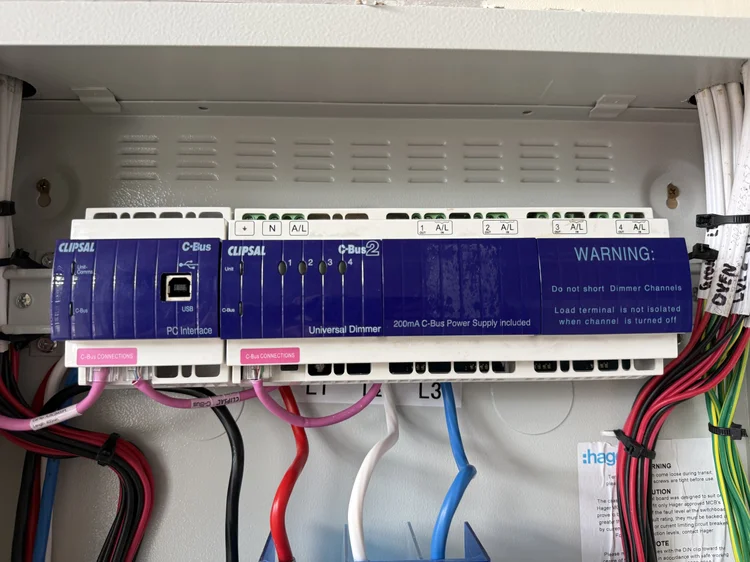
Some C-Bus specialists are programmers only — they can diagnose the software fault but can't legally touch the hardware. We hold NSW Electrical Contractor Licence 487170C, so we diagnose the fault and replace the dimmer, relay, or power supply in the same visit. One trade, one invoice, one visit.
How a Northern Beaches Callout Works
No hidden fees, no guesswork, and no pressure to replace a system that doesn't need replacing.
1. Book a Technician
Use the form below or call us. Tell us your suburb and what's happening. Residential from $295 across the Northern Beaches. Commercial and strata quoted on scope before we attend.
2. On-Site Diagnosis
We bring the C-Bus Network Analyser, Traffic Analyser, and Diagnostic Utility to every job. Most faults are identified within the first hour. We explain what we've found and what it takes to fix before doing any repair work.
3. Fixed & Tested
We repair or reprogram, test every affected zone, and walk you through what was done. Where an insurance claim is involved, we provide a written report documenting cause and extent of damage.
What Northern Beaches Clients Say
Verified reviews from homeowners across the Beaches and wider Sydney.
"The downlights connected to our C-bus system were flickering. Jason explained the issue in detail, provided a solution and the lights are now working perfectly. Highly recommend — a professional and honest approach delivering excellent work."
"Jason was reliable, knowledgeable and communicated the problem in simple terms to understand with patience. Highly recommend his ability to troubleshoot and solve the complicated light issues."
"Super happy with Cync Electrical. Jason was professional and honest, diagnosed the issue fast and got it sorted without any fuss. My C-Bus system is working perfectly again."
"He fixed the C-Bus issue very quickly and didn't leave any mess behind. Came out the next day. He will definitely be the first person I call next time something goes wrong."
Northern Beaches C-Bus Questions
What Beaches homeowners ask us most. Call 0422 253 379 if yours isn't here.
The most common cause in this region is interference on the mains supply rather than a fault in your C-Bus system. Ausgrid sends ripple control signals through the network to switch off-peak loads such as hot water systems. Electronic C-Bus dimmers chop the mains waveform precisely, and this injected signal distorts that waveform enough for the dimmer to misread it — producing flickering or unexpected dimming. Two signs confirm it: the flickering happens at random times rather than on a schedule, and lights plugged into ordinary power points are unaffected while dimmed C-Bus circuits misbehave. It typically becomes noticeable after a halogen-to-LED upgrade, because the much lower LED load no longer masks the interference the way 50W halogens did.
This catches a lot of Northern Beaches homeowners out. A halogen downlight draws around 50W; an equivalent LED draws a fraction of that. C-Bus dimmers were engineered around halogen loads, and that heavy load also had the side effect of masking mains interference. Strip it out and two things happen at once — the circuit may fall below the dimmer's minimum load threshold, and any signal interference on the supply is no longer swamped. The result is flickering that either appears for the first time or gets noticeably worse after the LED upgrade. Buying a different brand of LED globe usually doesn't fix it, because the problem isn't the globe.
Almost always, yes. Flickering is a circuit-level problem with a circuit-level fix — the right LED downlights, a more suitable dimmer module with the minimum load threshold adjusted in C-Bus ToolKit, or in severe cases moving that circuit onto a relay so it isn't dimmed at all. None of those require replacing the system. If you've been told your C-Bus needs full replacement because lights are flickering, we'd strongly suggest getting a second opinion first. We attended a Cromer home after a storm where the owner had been advised to replace the entire system, and we resolved the actual faults in a single visit.
Yes. We inspect the system, identify what's actually been damaged, and provide a written report documenting the cause and extent of damage suitable for submission to your insurer, along with a quotation for the recommended repairs. Storm events on the Beaches commonly damage C-Bus power supplies and dimmer modules, and often connected equipment such as pool controls and underfloor heating. One thing worth knowing: an insurance claim doesn't make an unnecessary replacement necessary. We report on what's genuinely damaged, which sometimes means a much smaller claim than a homeowner has been told to expect.
Several possibilities: a forgotten schedule still running in the project file, a PIR sensor that's drifted in sensitivity, a logic condition misfiring, or a third-party device sending commands onto the network. There's also a cause we see regularly in Beaches apartments — a fitting that should never have been dimmed wired onto a dimmer channel by an electrician unfamiliar with C-Bus. It behaves erratically because it's on the wrong type of output entirely. We found exactly this in a Queenscliff apartment recently. The C-Bus Traffic Analyser identifies which of these it is quickly.
Yes. A lot of Northern Beaches apartments and newer homes run DALI fittings alongside or integrated with C-Bus. We replace failed DALI drivers and fittings and reprogram them correctly back into the system. That combination matters — a general electrician can swap a fitting but often can't reprogram it into the control system, and a programmer-only specialist can reprogram but can't legally do the electrical work. We do both.
Residential C-Bus diagnostic and repair visits start from $295 across the Northern Beaches, covering arrival, on-site diagnosis, and minor adjustments. Many programming faults are resolved within that first visit. Hardware replacement incurs parts costs on top, quoted before work proceeds. Commercial and strata jobs are quoted on scope before we attend. There are no hidden call-out fees.
Yes, and it's very common on the Beaches — many of these homes have changed hands since the system was installed and the original installer is long gone. In most cases we recover the project file directly from the network by scanning it with C-Bus ToolKit, which gives us a complete map of every unit, group address, scene, and schedule. We work from that recovered file. Where full recovery isn't possible we rebuild from a site walkthrough. Either way you're not starting from scratch, and we leave you with a backup copy.
Book a Northern Beaches C-Bus Technician.
Submit a booking request and we'll confirm the earliest available time. Been quoted for a full system replacement? Get a second opinion first — call 0422 253 379.
This is a booking request — we'll confirm the appointment time before attending. Residential, strata and commercial enquiries welcome.
C-Bus Service Across Every Northern Beaches Suburb
From Manly through to Palm Beach and west to the Forest — we cover the whole peninsula for C-Bus fault finding, repairs, reprogramming and upgrades.
Manly & Southern Beaches
Dee Why to Narrabeen
Pittwater & Northern Peninsula
Forest District
Same-day diagnosis available for urgent Northern Beaches C-Bus faults.